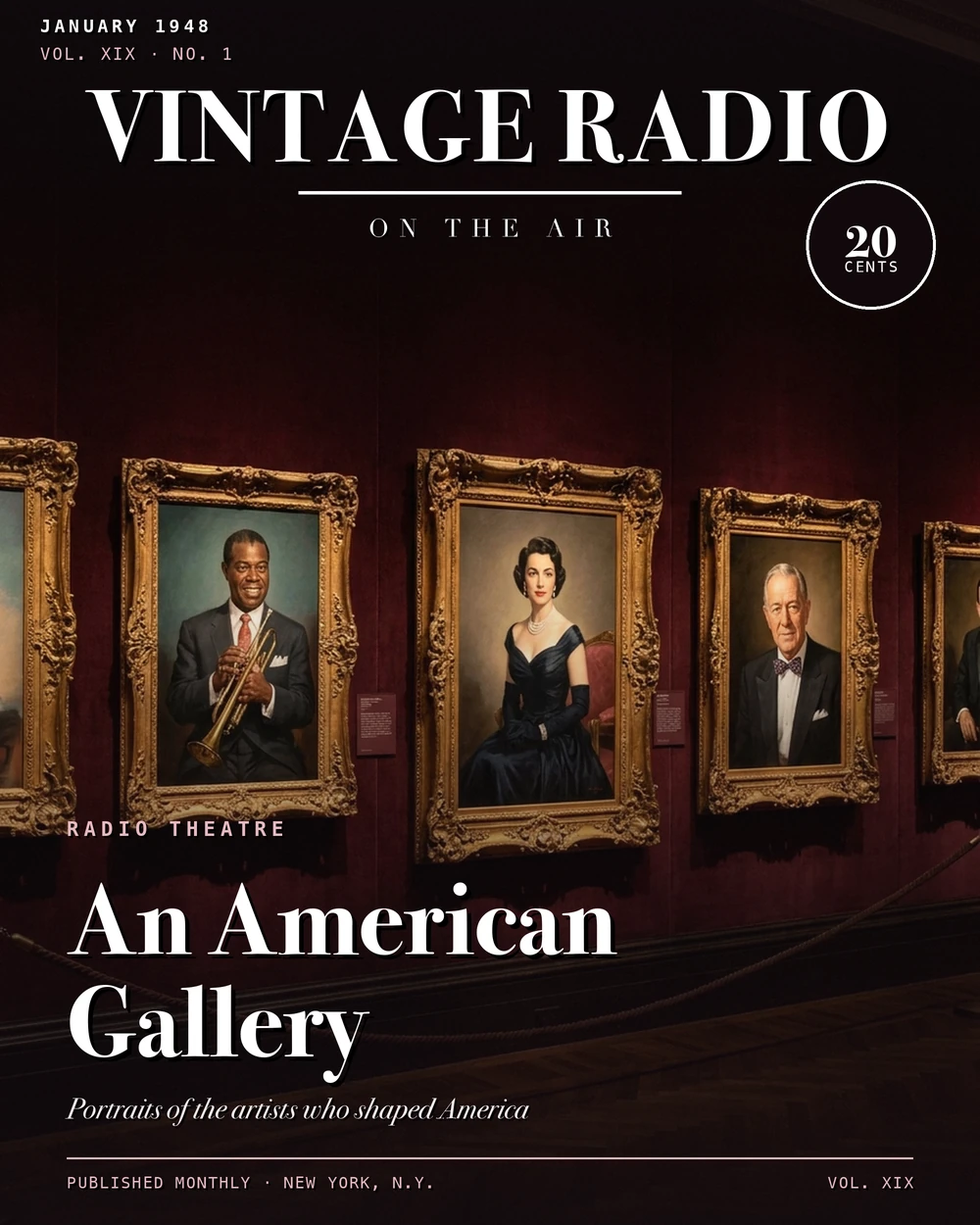
An American Gallery
Famous People, Telling Stories About Famous People
The central idea behind An American Gallery was simple and rather elegant: take a celebrated American artist — a sculptor, a jazzman, a novelist, a photographer — and let another famous American entertainer tell that person's story. The result was a series of biographical radio portraits, each roughly half an hour long, that treated American creative life as a gallery worth walking through carefully, one exhibit at a time. The narrators were, by design, as well-known as the subjects they introduced. That pairing gave the show its distinctive texture. When Bing Crosby introduces Louis Armstrong, or Edward G. Robinson talks about Frederic Remington, the conversation already carries weight before a word of the story is spoken.
The series ran to twelve recorded episodes, with a total runtime of approximately five hours and forty-seven minutes — about twenty-nine minutes apiece. The production style reads as documentary-biographical drama rather than pure fiction, the kind of radio that aimed to put a real person's life in front of a general audience in a way that felt intimate rather than academic. One listener source places production in the 1960s, with the background music and speech style consistent with that decade.
The Subjects and the People Who Introduced Them
The range of subjects across the twelve episodes reflects a deliberately broad definition of "artist." Louis Armstrong appears alongside sculptor John Gutzon Borglum, architect Frank Lloyd Wright, novelist Thomas Wolfe, painter and illustrator Frederic Remington, photographer Matthew Brady, and composer George Gershwin. Filmmaker Cecil B. DeMille was covered as well. The show wasn't limiting "artist" to canvas and brushes — it was building a portrait of American creative achievement across disciplines.
The casting of narrators showed the same breadth. Bing Crosby hosted the Armstrong episode, tracing the beginnings of Armstrong's life in jazz. Bob Hope explored the life and philosophy of Will Rogers in "The Man Everybody Liked." Lorne Greene hosted the episode on Borglum, the man who carved Mount Rushmore — a broadcast with an archived sample date of May 19, 1950. Edward G. Robinson took on Remington. Raymond Burr hosted the Matthew Brady episode, "Portrait of a Photographer." Novelist Irving Stone narrated the story of fellow novelist Thomas Wolfe. John "Bubbles" Sublett introduced the Gershwin episode, "Porgy Bess and George." Charlton Heston hosted the Cecil B. DeMille installment.
One of the more personally charged pairings in the series was Anne Baxter narrating the episode on Frank Lloyd Wright — who was her grandfather. That connection gave the episode a dimension no outside commentator could have brought to it.
What the Episodes Covered
The full roster of episode titles gives a clear picture of how the series moved across American life. "Satchmo-The Louis Armstrong Story" and "Porgy Bess and George" address music. "A Story of Two Giants" covers Borglum and Mount Rushmore. "Portrait of a Photographer" turns to Brady and his Civil War documentation. "Westward the Painter" almost certainly refers to Remington. "Henry Wadsworth Longfellow Poet" brings in American literature. "Count-Down for a Champ" and "Flight Before Fury" suggest episodes that may touch on athletic or competitive achievement, though the specific subjects aren't confirmed in available sources.
"To Hear a Different Drummer," "A Day to Test a Day to Learn," and "A Review of Coming Attractions" round out a catalog that moves comfortably between the arts, history, and American culture. Across all twelve, the series maintained its format: one subject, one narrator-host, roughly half an hour, biographical in structure.
The Production Context
An archived catalog item for the series identifies it as an audition episode for "American Armed Forces Radio No. 44," which suggests the show was produced for or distributed through Armed Forces Radio. That context would fit the series well — biographical profiles of American artists, told by recognizable American entertainers, aimed at an audience of American service members abroad. The format would travel easily, requiring no visual component and relying on names and stories that a general American audience could be expected to recognize.
The show has been cross-referenced alongside programs like Cavalcade of America, Destination Freedom, and American Portraits — all series that worked in biographical or historical radio drama. It's also been grouped with Academy Award Theater, Campbell Playhouse, and Damon Runyon Theater as programs sharing a similar anthology storytelling approach. The company is instructive: An American Gallery sat comfortably in a tradition of prestige radio that treated real people and real history as worthy dramatic material.
Why the Format Worked
The appeal of An American Gallery rests on a specific kind of double attention. The listener is hearing about Louis Armstrong, yes — but also hearing Bing Crosby talk about Louis Armstrong, and those are two different experiences layered on top of each other. The narrator is never an anonymous voice; the narrator is somebody, with their own career and reputation, lending that standing to the story they're telling. Irving Stone, a novelist himself, bringing his own craft to the story of Thomas Wolfe — there's something in that arrangement that a generic radio announcer couldn't replicate.
The biographical-drama format also meant the show wasn't asking its audience to follow invented characters through invented situations. The people were real, the careers documented, the work already part of American cultural life. Each episode functioned as a kind of introduction or reintroduction — here is what this person made, here is how they got there, here is someone you already know vouching for why it mattered. Twelve episodes, twelve artists, twelve different corners of American creative achievement, all handled in about half an hour apiece. The series was compact by design, and that compactness suited the format well.